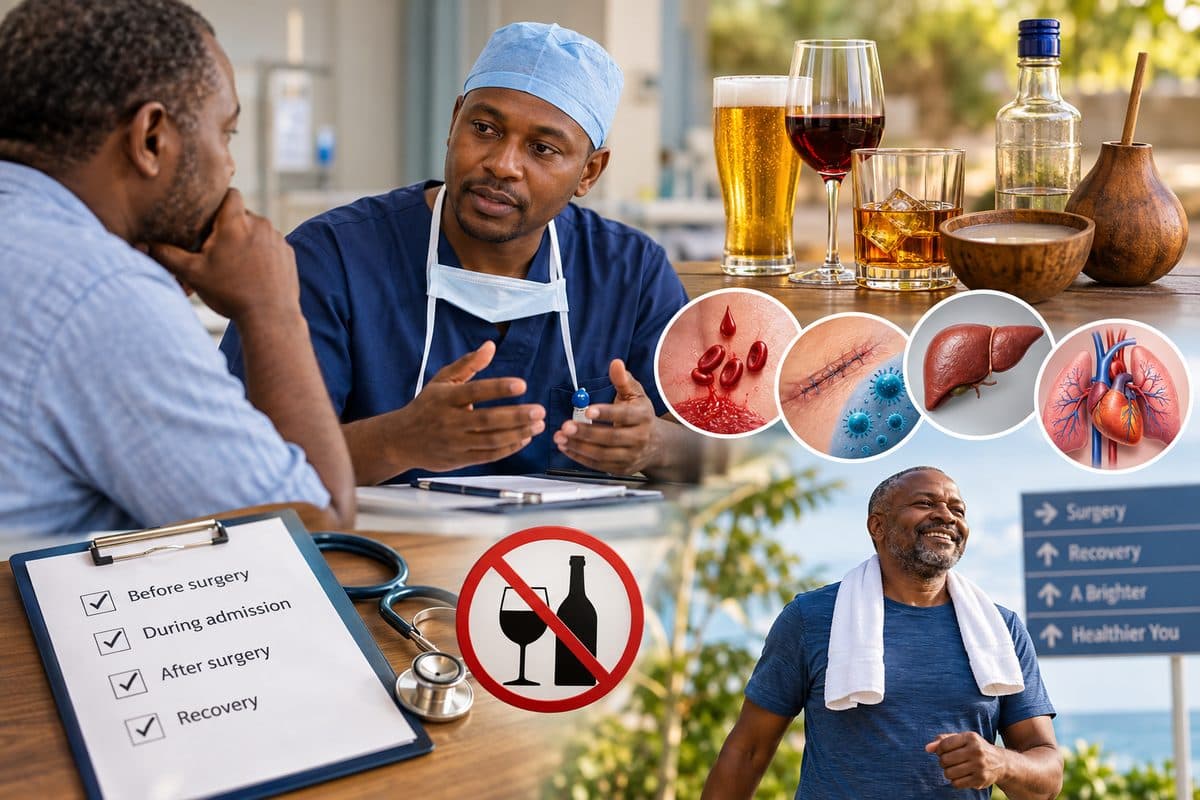
Alcohol affects healing, bleeding, infection and anaesthesia. Why your surgeon asks how much you drink, why stopping a few weeks before an operation helps, and why heavy drinkers should never stop suddenly without advice.
Before every planned operation, I ask my patients the same question: "How much alcohol do you drink in a typical week?" Some laugh. Some look away. A few are offended, as if I were passing judgement. I am not. The answer helps me keep you safe, and it can change how I prepare you for surgery, how I look after you afterwards, and sometimes when the operation should take place.
Alcohol is part of social life in Kenya, from a cold beer after work to celebrations, weddings and funerals. Most people never connect it with what happens in an operating theatre. Yet regular drinking quietly affects almost every system the body depends on to get through surgery and heal afterwards.
Why alcohol matters to your surgeon
Surgery is a controlled injury. To recover, your body has to stop bleeding, fight infection, repair tissue and keep your heart, lungs, liver and kidneys working under stress. Regular alcohol use weakens each of these.
- Bleeding. Alcohol affects platelets and, in people with liver damage, the clotting proteins the liver produces. This can mean more bleeding during and after surgery.
- Infection. Alcohol suppresses the immune system. Wound infections, chest infections and urinary infections are more common in people who drink heavily.
- Wound healing. Good healing needs good nutrition, steady blood flow and an immune system that works. Heavy drinking undermines all three, so wounds heal more slowly and are more likely to break down.
- Heart and lungs. Alcohol can cause irregular heart rhythms and weaken the heart muscle. It also increases the risk of inhaling stomach contents and of chest infections after anaesthesia.
- Liver. The liver processes many anaesthetic drugs and painkillers. A liver strained by alcohol handles them less predictably and copes less well with the stress of surgery.
Large studies across many countries have shown the same pattern: people who drink above recommended limits have more complications after surgery. These include infections, bleeding, heart and lung problems and longer hospital stays. The more someone drinks, the greater the risk.
How much is "too much"?
There is no completely safe level of alcohol, but risk rises clearly with regular drinking. Many guidelines use a standard drink, which is roughly one bottle of ordinary beer, one small glass of wine or one tot of spirits.
As a practical guide, tell your surgeon if any of the following apply to you:
- You drink most days of the week.
- You regularly have more than two drinks on an occasion.
- You sometimes drink heavily at weekends or at functions.
- You need a drink in the morning, or feel shaky, sweaty or anxious when you go without.
Remember that home-brewed and informally sold drinks such as chang'aa and busaa vary widely in strength. A single cup may contain far more alcohol than you think.
The danger of stopping suddenly
This is the most important message in this article. If you drink heavily every day, do not suddenly stop on your own before surgery without speaking to a doctor.
When someone who is physically dependent on alcohol stops abruptly, the brain reacts. This is alcohol withdrawal. Symptoms can begin within hours: tremor, sweating, a racing heart, anxiety and poor sleep. In more severe cases, seizures and a dangerous state of confusion with hallucinations, known as delirium tremens, can develop over the following days. This can be life-threatening.
Withdrawal often appears for the first time after admission to hospital, because that is the first time in years the person has gone a day without a drink. A patient who seems confused, agitated or unwell two or three days after an operation may in fact be withdrawing from alcohol. If we know in advance, we can prevent it safely with the right medicines and monitoring. If we do not know, it can be mistaken for something else, and treatment may be delayed.
So please be honest. What you tell your surgical team is confidential, and it is used only to keep you safe.
Stopping before planned surgery helps
The good news is that the body recovers quickly. Research shows that people who stop drinking for several weeks before planned surgery have fewer complications than those who continue. Studies of structured programmes to help patients stop drinking before an operation show a meaningful reduction in complications.
As a general guide:
- Ideally, stop drinking at least four weeks before planned surgery, and longer if you can. Six to eight weeks is better still.
- Even a shorter period helps. Every alcohol-free day before surgery gives your body a better chance.
- If you drink heavily or daily, get help to stop safely. Your doctor can advise on a supervised plan and may prescribe medicines to prevent withdrawal.
- Do not drink at all in the 24 hours before your operation. Alcohol interferes with anaesthesia and increases the risk of vomiting and inhaling stomach contents.
For urgent and emergency surgery there is no time to stop beforehand. That is exactly why your team needs to know, so that withdrawal can be anticipated and prevented.
After the operation
Recovery is not the time to return to drinking. In the days and weeks after surgery:
- Alcohol and painkillers do not mix. Combined with strong painkillers or sleeping tablets, alcohol increases drowsiness and can slow breathing. Anti-inflammatory painkillers such as ibuprofen and diclofenac, taken with alcohol, increase the risk of stomach bleeding. Heavy drinkers may need lower doses of paracetamol, so ask your doctor.
- Alcohol and blood thinners do not mix. Many patients go home on medicines to prevent clots. Alcohol makes the risk of bleeding less predictable.
- Alcohol slows healing. Skin wounds, joins in the bowel (anastomoses) and blood vessel repairs all need the best possible conditions to heal.
- Never drink after sedation. For at least 24 hours after a sedated procedure, such as an endoscopy or colonoscopy, avoid alcohol completely, along with driving and important decisions.
Ask your surgeon when it is safe to drink again. For many people, the weeks around surgery become the start of drinking less for good.
An opportunity, not a lecture
I have operated on many people who drink, and I will continue to do so. Asking about alcohol is not about judging anyone. It is the same as asking about diabetes, blood pressure or smoking. These are factors we can plan for and, very often, improve before surgery.
A planned operation can be a powerful moment to change. Many patients tell me that stopping for surgery showed them how much better they sleep, think and feel without alcohol. Some never go back.
If you are preparing for surgery and are worried about your drinking, speak to us. If you find it hard to cut down, ask your doctor about support. There is no shame in asking for help, and it may be one of the best things you do for your recovery.
Be honest with your surgeon about alcohol. It is one of the simplest ways to make your operation safer.
This article is general information and does not replace individual medical advice. In an emergency, go to the nearest Accident & Emergency department.